Braces & Aligners in Kothrud, Pune
Braces & Aligners for Every Age
Whether you're a teenager or starting in your 40s, Aesthedent offers metal braces, ceramic braces and clear aligners tailored to your smile goals.
About Orthodontic Treatment in Kothrud
It's never too late to invest in your smile. Whether you're a teenager, a young professional, or even in your 40s, modern orthodontic options allow for treatment that fits discreetly into your daily life without disrupting your work, appearance, or confidence.
At Aesthedent, every orthodontic case begins with a clinical evaluation of your bite, jaw alignment, and tooth positioning — not a one-size-fits-all recommendation. This assessment determines which treatment approach will give you the most predictable, stable result for your specific case.
Which option is right for you depends on the complexity of your case, your treatment goals, and your lifestyle — something we determine together during your initial consultation, not before it.
Treatment duration varies by case but typically averages 18 to 24 months. Throughout this period, we schedule regular monitoring visits — generally every 4 to 6 weeks — to track progress, make adjustments, and ensure your treatment stays on course. That cadence is why nearly all of our orthodontic patients live close by, in Kothrud and Karve Nagar: over a two-year course, ten minutes each way is the difference between keeping appointments and quietly abandoning them.
At the end there is a retainer, and it is not optional. Teeth drift back if nothing holds them.
Types of orthodontic treatment we offer
Metal braces
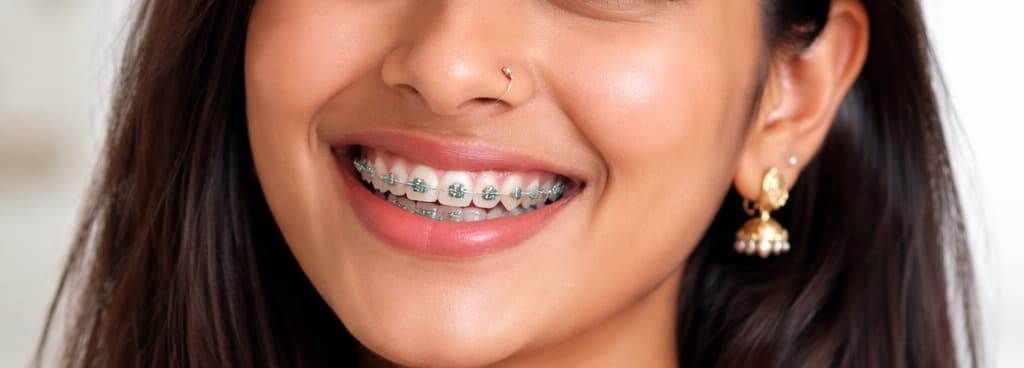
The most time-tested and versatile option, effective for both simple and complex misalignments, including cases involving significant crowding or bite correction.
Ceramic braces
Function like metal braces but use tooth-coloured brackets, offering a less visible alternative for patients who want effective correction with a more discreet appearance.
Clear aligners
A series of custom, removable trays that gradually shift teeth into position. Best suited for mild-to-moderate misalignment, and popular among working professionals for their near-invisibility and convenience.
What braces & aligners does for you
- Discreet options for adults who would rather the treatment were not obvious
- Metal braces remain the most predictable choice for complex movements
- Suitable from childhood through to adulthood — bone responds at 40 as it does at 14
- Short adjustment appointments every 4 to 6 weeks, close to home
- Straighter teeth are easier to clean, which helps the gums long-term
- A retention phase planned in from the start, not added as an afterthought
Why patients choose us for this treatment
Assessment before recommendation
Every case starts with a clinical evaluation of your bite, jaw alignment and tooth positioning. Which appliance suits you is decided during that consultation, not before it.
An honest answer about aligners
Aligners only work while they are in your mouth, which realistically means around twenty-two hours a day. If your case or your habits suit fixed braces better, we will say so rather than sell the tidier option.
The schedule is part of the decision
Eighteen months to two years, with a visit every four to six weeks. We would rather you weighed the cumulative travel honestly at the start than abandoned treatment halfway.
Retention planned from the outset
Treatment is not finished when the appliance comes off. Retainers hold the result, and skipping them is the single most common reason people need orthodontics twice.
What to expect, step by step
Clinical evaluation and records
Photographs, scans and X-rays, plus an assessment of your bite, jaw alignment and tooth positioning — which is often not what the mirror suggests.
Choose the appliance together
Metal, ceramic or clear aligners, chosen against the complexity of your case, your goals and your lifestyle rather than a default recommendation.
Plan, timeline and full cost
Expected duration, visit frequency, and the total figure including the retention phase — agreed before the first bracket is bonded.
Fitting
The appliance is fitted or the first aligners issued. Some tightness for a few days afterwards is normal and settles.
Monitoring every 4 to 6 weeks
Short appointments to track progress and make adjustments, keeping the treatment on course over the full 18 to 24 months.
Retention
Retainers fitted and explained, because this is the stage that decides whether the result you paid for is still there in five years.
Common questions
Am I too old for braces?
No. Teeth move through bone by the same mechanism at any age, so adult orthodontics is entirely routine. It can take somewhat longer than in a teenager, and clear aligners make it far less conspicuous at work.
How long does treatment take?
Commonly eighteen months to two years, though simple cases finish sooner and complex ones run longer. You will get an estimate for your case before you commit, not a generic range.
How often will I need to come in?
Roughly every four to six weeks for an adjustment. The appointments themselves are short. It is the cumulative travel over two years that people underestimate, which is worth factoring in when choosing a practice.
Braces or clear aligners - which is better?
Neither, in the abstract. Fixed braces give more predictable control for complex movements and work whether you cooperate or not. Aligners are removable and discreet but only work while worn, which realistically means about twenty-two hours a day. The honest question is which suits your case and your habits.
Does it hurt?
Not the fitting itself. For a few days after fitting and after each adjustment the teeth feel tender and biting into hard food is uncomfortable. It settles, and ordinary painkillers cover it.
What is the right age for a child to be assessed?
Around seven is the usual recommendation for a first look, because that is when problems with the developing bite become visible. That does not mean treatment starts then - most begins between ten and fourteen, once enough permanent teeth are through.
Do I really have to wear a retainer afterwards?
Yes. Teeth have a strong tendency to drift back toward where they started, particularly in the first year. A retainer is what holds the result. Skipping it is the single most common reason people end up needing treatment twice.
What do braces cost in Pune?
It depends on which appliance and how long the case runs - aligners and fixed braces are priced differently. You get the full figure, retainers included, before anything is fitted.