Tooth-Coloured Fillings in Kothrud, Pune
Small Repairs. Big Difference.
Invisible, strong, and conservative restorations for cavities — durable, aesthetic results with a minimally invasive approach.
About Tooth-Coloured Fillings in Kothrud
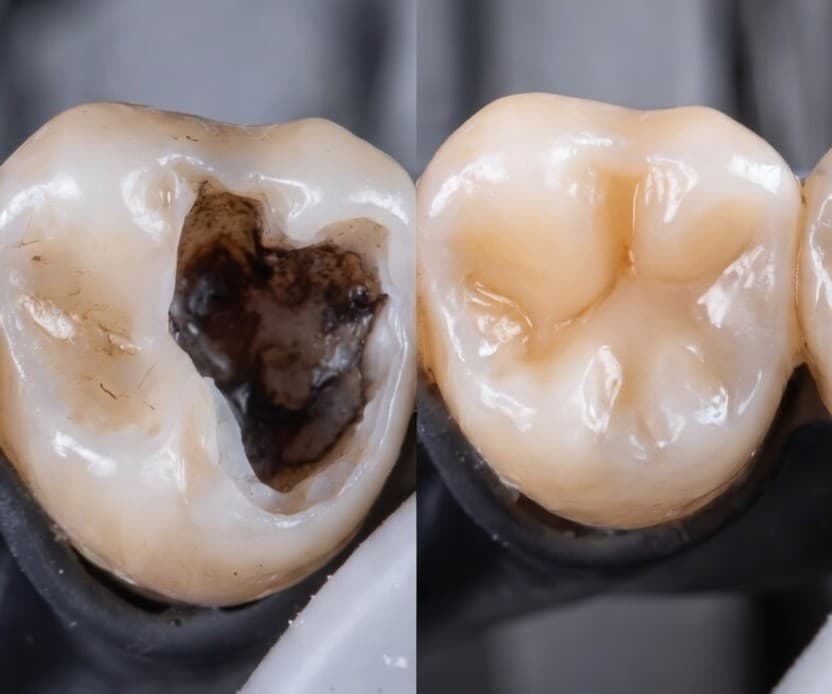
Tooth-coloured fillings, also known as composite resin restorations, treat cavities while preserving as much of your natural tooth as possible. The composite material is custom shade-matched to your enamel before application, so the repair blends invisibly into your smile.
What sets composite resin apart from traditional silver amalgam fillings is how it attaches to the tooth. Amalgam fillings rely on mechanical retention, often requiring removal of healthy tooth structure just to hold the filling in place. Composite resin, by contrast, bonds directly to the tooth at a micro-mechanical level — allowing us to take a more conservative approach, removing only the decayed portion rather than reshaping the tooth around the filling.
The composite is applied and hardened in thin layers using a curing light, which minimizes shrinkage and creates a tight seal at the edges of the restoration — reducing the risk of leakage or decay returning around the filling later. The result is a restoration that's not just cosmetically seamless, but also restores the tooth's natural strength and function, typically completed in a single visit with no metal, mercury, or dark spots.
Everyday restorative work here is done by Dr. Aishwarya Kulkarni Wathodkar, BDS, Bharati Vidyapeeth, Pune, a general and family dentist. Most of these patients are simply local — Kothrud and the Paud Road side — because for a half-hour appointment nobody sensibly drives across Pune.
What tooth-coloured fillings does for you
- Custom shade-matched to your enamel before placement
- Bonds micro-mechanically, so only the decayed portion is removed
- Layered and light-cured to minimise shrinkage and seal the margins
- Restores the tooth's natural strength and function, not just its appearance
- Typically a single visit, with no metal, mercury or dark spots
Why patients choose us for this treatment
Conservative by default
Because composite bonds rather than wedges, we remove decay rather than reshaping sound tooth around a filling. Tooth structure you keep is tooth structure you never have to replace.
Layered and cured properly
Thin increments, each light-cured, rather than one bulk fill. It takes longer in the chair and it is what produces a tight marginal seal instead of a gap that lets decay back in.
We will say when a filling is the wrong answer
A badly broken tooth or one that has lost a cusp needs a crown. Placing a large filling there produces a restoration that fails within a year, and we would rather show you why on the scan.
The bite is checked before you leave
A filling left a fraction high is the most common reason a tooth aches afterwards. It takes a minute to check and saves a return visit.
What to expect, step by step
See the cavity yourself
On the intraoral camera or X-ray, so you can judge the size of it rather than take our word for how urgent it is.
Confirm a filling is right
For a cavity, yes. For a badly broken tooth, we will explain why a crown will outlast a large composite.
Shade match, then agree the cost
The composite shade is selected against your own enamel in natural light, and the figure is confirmed before we begin.
Anaesthetic if you want it
Shallow cavities often need none, but that is your call rather than ours. There is no prize for going without.
Remove decay and bond in layers
Only the decayed portion is removed, then the composite is placed in thin increments and light-cured to control shrinkage.
Polish and check the bite
Polished so it feels like tooth rather than a patch, then the bite is checked and adjusted before you leave.
Common questions
How are these different from silver fillings?
They are composite resin rather than amalgam, matched to your tooth shade so they are effectively invisible. They also bond to the tooth, which means less healthy tooth needs to be cut away to hold them in place.
How long do tooth-coloured fillings last?
Commonly five to ten years, often longer. It depends on where the filling is, how heavily you bite on it, whether you grind your teeth, and how well the area is cleaned.
Does having a filling hurt?
Shallow fillings often need no anaesthetic at all. Deeper ones are done under local anaesthetic and you should feel pressure rather than pain. If you would rather be numb regardless, just say so.
Should I replace my old metal fillings?
Not automatically. A sound amalgam filling that is not leaking, cracked or decaying underneath is usually best left alone - replacing it means removing more tooth. If yours does need replacing, we will show you the reason on the X-ray.
Can a filling fix a chipped front tooth?
Often, yes. Composite bonding can rebuild a chipped edge in one visit. For larger fractures or heavily worn front teeth, a veneer or crown may hold up better, and we will tell you which applies.
My tooth is sensitive after a filling. Is that normal?
Mild sensitivity to cold for a week or two is common, especially with deeper fillings. What is not normal is pain on biting or sensitivity that worsens - that usually means the filling is fractionally high or the nerve is irritated. Come back and we will check it.